
On January 20, 2027, the new Machinery Regulation (EU) 2023/1230 will replace the familiar Machinery Directive. It will no longer be a directive transposed by each country, but a single regulation that applies directly.
A lot of attention is rightly being paid to cybersecurity and software. However, classic risks remain a standard part of any risk assessment.
One of these is often underestimated in practice: hot surfaces.
Heated molds. Press plates. Sealing jaws. Oven walls. Wherever a machine uses heat, there is a surface that an operator or technician could touch.
One touch is all it takes.
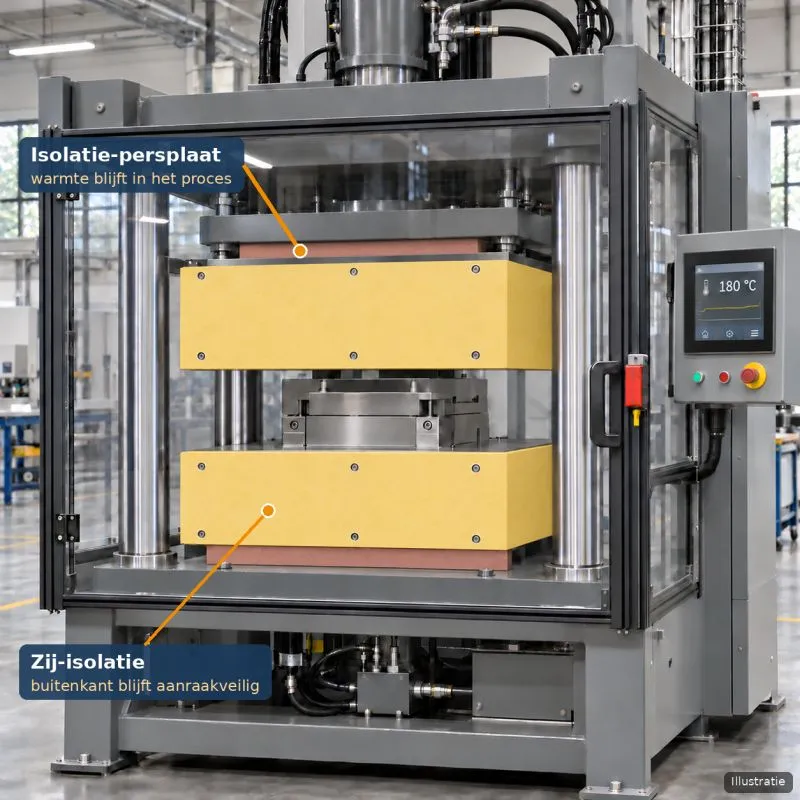
Take a rubber press at 180 °C. With insulation plates between the heated plates and the press, and on the sides, the exterior remains below 60 °C—well below the threshold where contact causes burns.
The usual solutions? A warning sticker. An extra cover. A guard that has to be removed for maintenance. There is a more structural approach: insulating the heat where it is generated.
With high-quality insulation plates, the heat stays in the process, and the exterior remains safe to touch. This provides two benefits:
✅ A safer machine, demonstrably supported in your risk assessment
✅ Less heat loss, resulting in lower energy consumption and a more stable process
Safety and efficiency in a single design choice.
Anyone designing a machine now is already designing for the new regulation. This is the moment to take a conscious look at heat sources.
How do you handle hot surfaces in your machines: shielding or insulating?
Auteur:
Gerard Worm


